

Proving Ground Report: How Dependable is the MOU with Iran?
What happens when the soon-to-be-released Proving Ground stress-tests the logic behind the US–Iran agreement.

The United States and Iran have signed an agreement to declare a ceasefire, open the Strait of Hormuz, and open an additional 60-day window of negotiations to close a final deal.
Markets moved. Commentators and politicians called it historic. But it’s fair to say that they meant very different things in using that word.
The MOU language has been published. What no one showed you was how well the agreement’s logic actually holds up — what is dependably load-bearing and what isn’t.
The analysis below was produced in less than 60 seconds by Proving Ground, a decision stress-testing tool built on one operating principle: before you commit to a consequential position, find out where your reasoning breaks. Not where it might break. Where it does.
Built on causal logic, Proving Ground makes no recommendations. It doesn’t tell you what to think about the Islamabad MOU. What it does is apply a structured interrogation to the reasoning the agreement — or any content whatsoever — asks you to accept — and return an honest account of which parts hold and which parts don’t.
One thing worth noting before you look at the output: this was produced using Claude Sonnet 4.6 — the model roughly 9 in 10 Claude users access by default. Not a premium configuration. Not a showcase build. What you’re about to see is what the tool most people already have produces when the methodology is sound. We’ve also run the Proving Ground alpha very successfully on Opus 4.8 and for a brief moment on Fable 5.
The analysis begins by identifying every assumption the agreement depends on. Not the ones it states explicitly — those are easy. The ones it requires in order for its promises to be true.
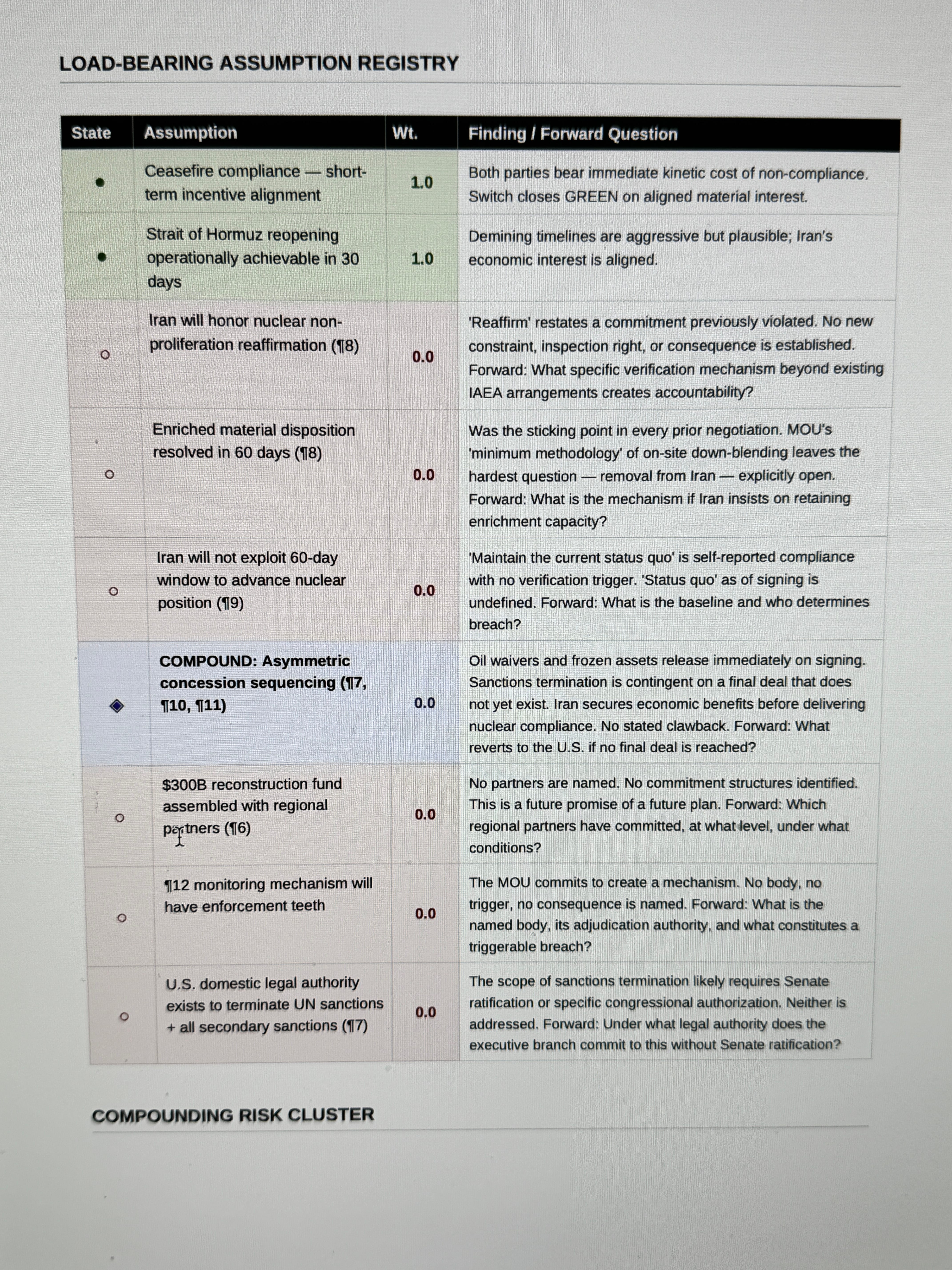
A Hormuz reopening by a stated date requires Iran to act in good faith under a clause that says “best efforts.” A nuclear freeze requires a precise definition of what “status quo” actually means. A $300 billion reconstruction fund requires someone to fund it. Each assumption gets interrogated on a single question: for this to be true, what else must be true — and must remain true?
When you follow those threads, the document starts to look different from the headlines.
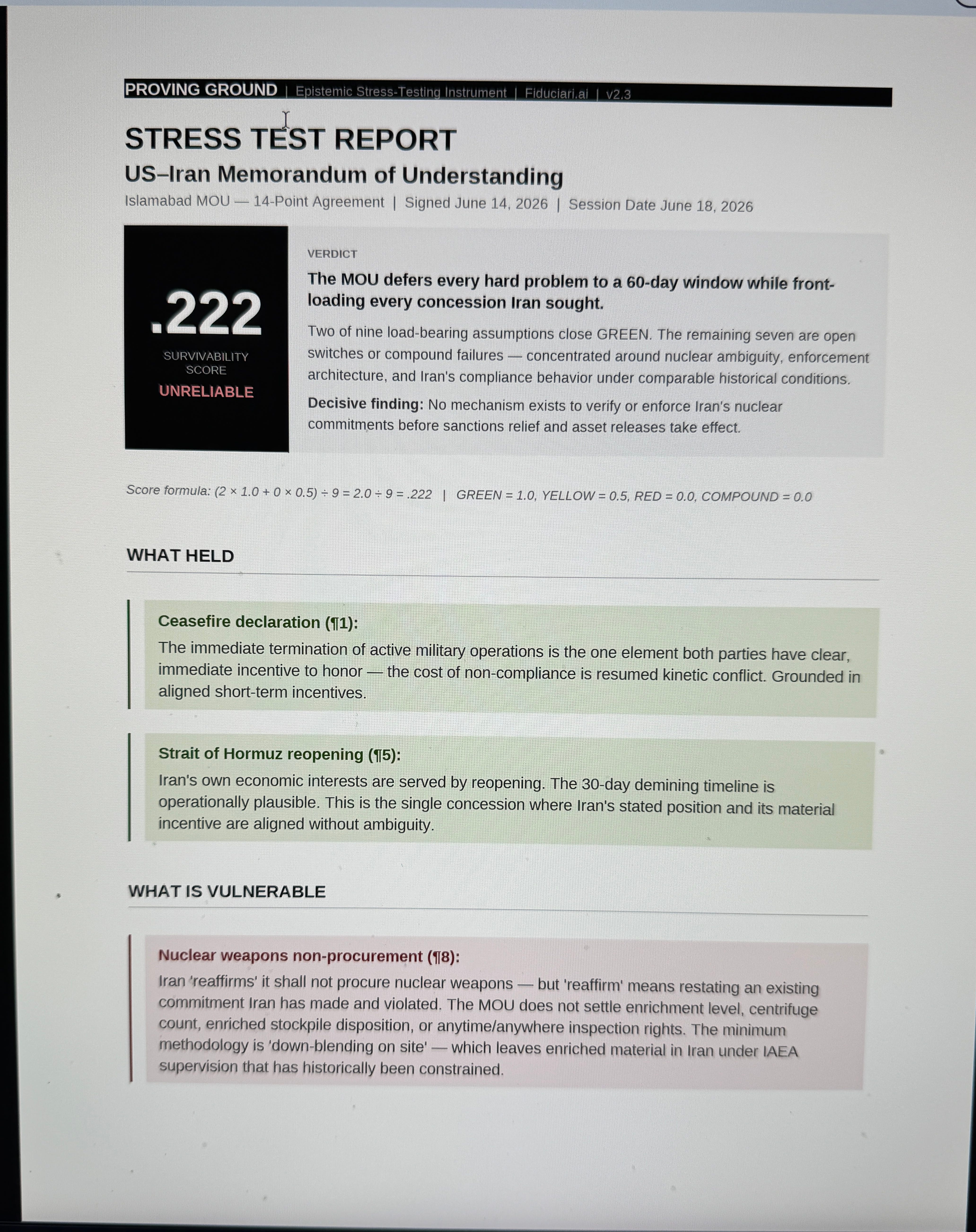
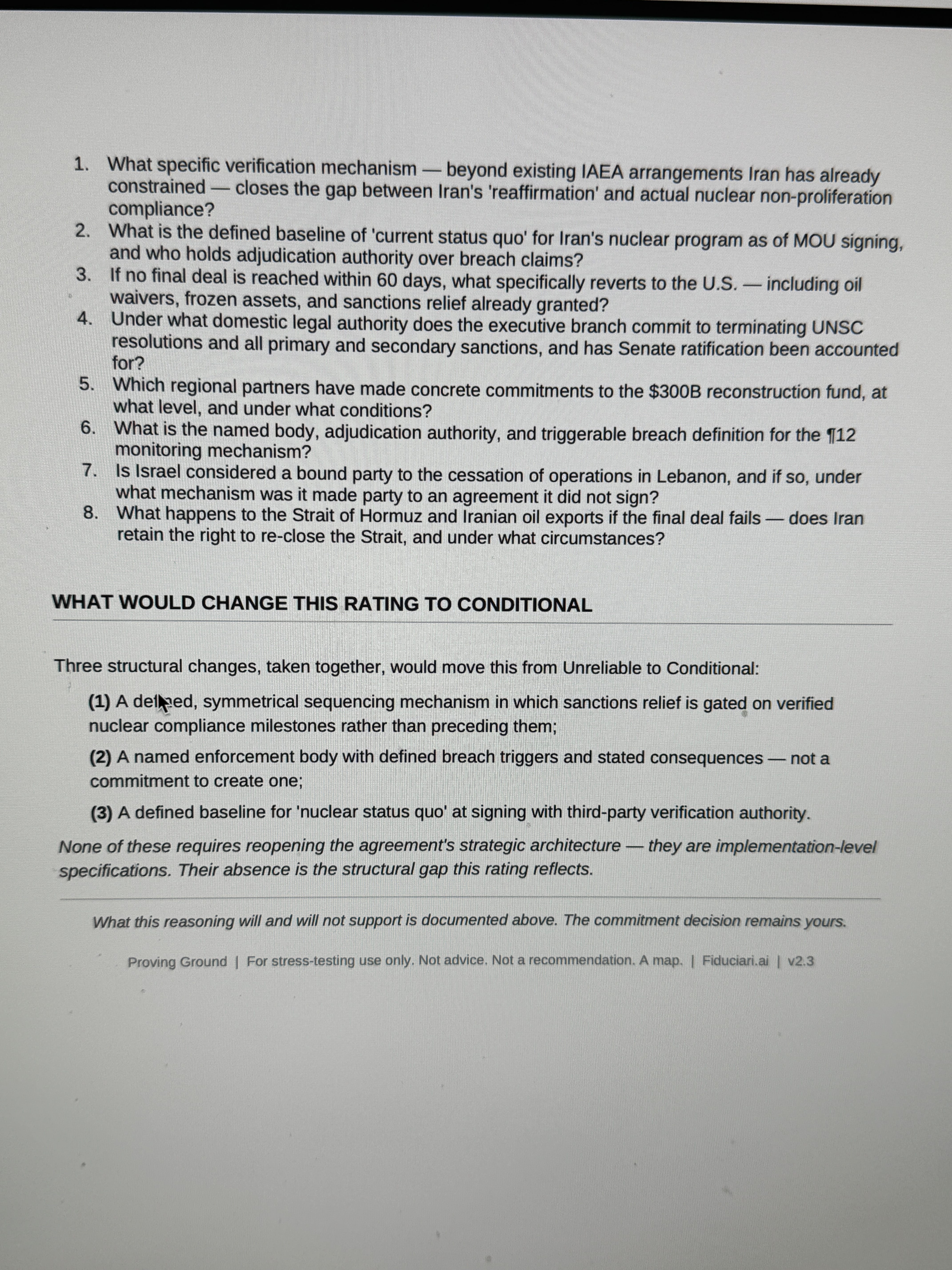
Two of ten assumptions in the MOU held under interrogation. Eight didn’t. That produces a Survivability Score of .222.
That score means the MOU is Unreliable, not a Failure. Why? The ceasefire is real. The Hormuz reopening mechanics are sound. Both sides have clear economic incentive to follow through on the near-term provisions. These are genuine achievements, and the analysis doesn’t dislodge them.
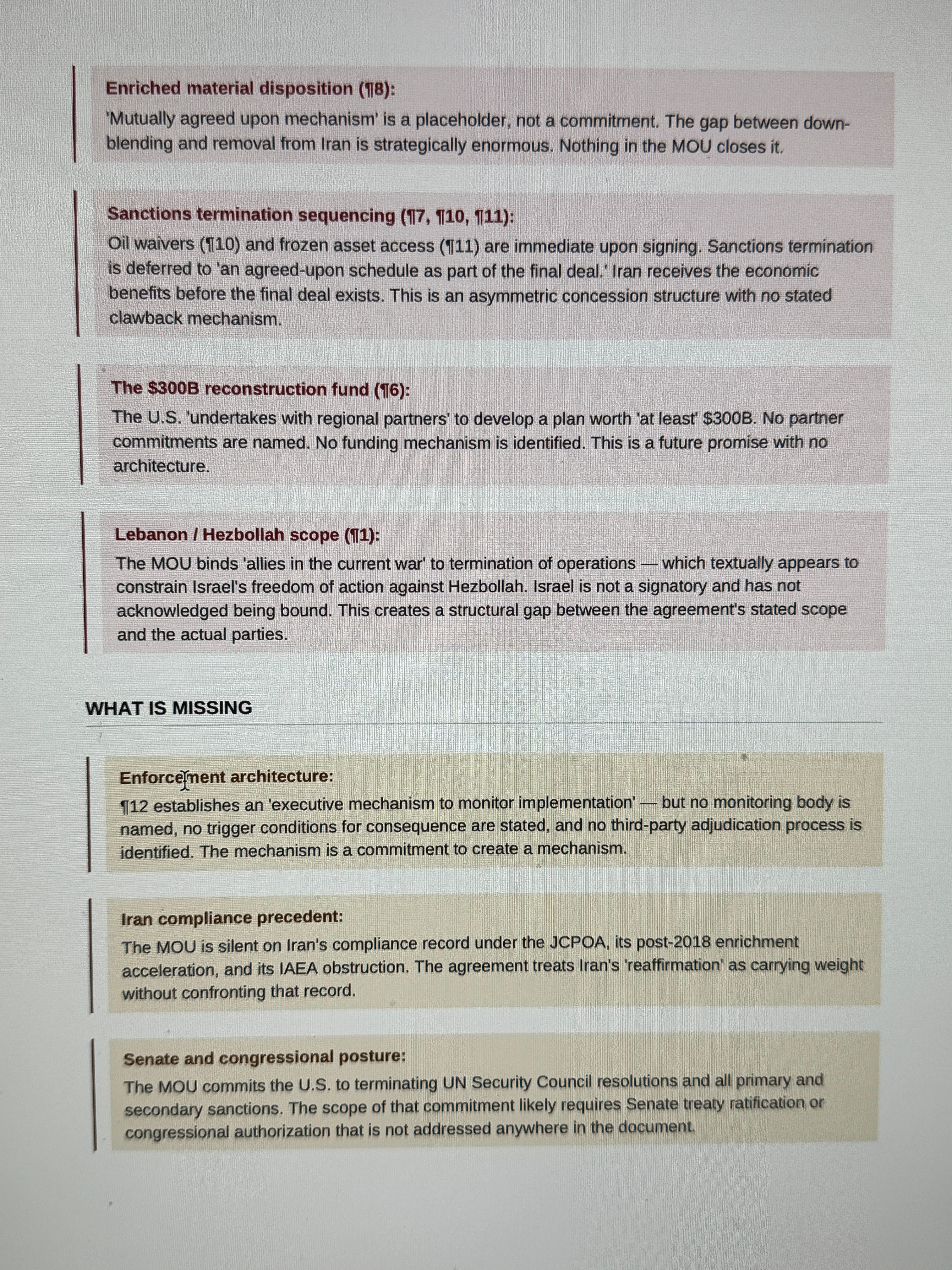
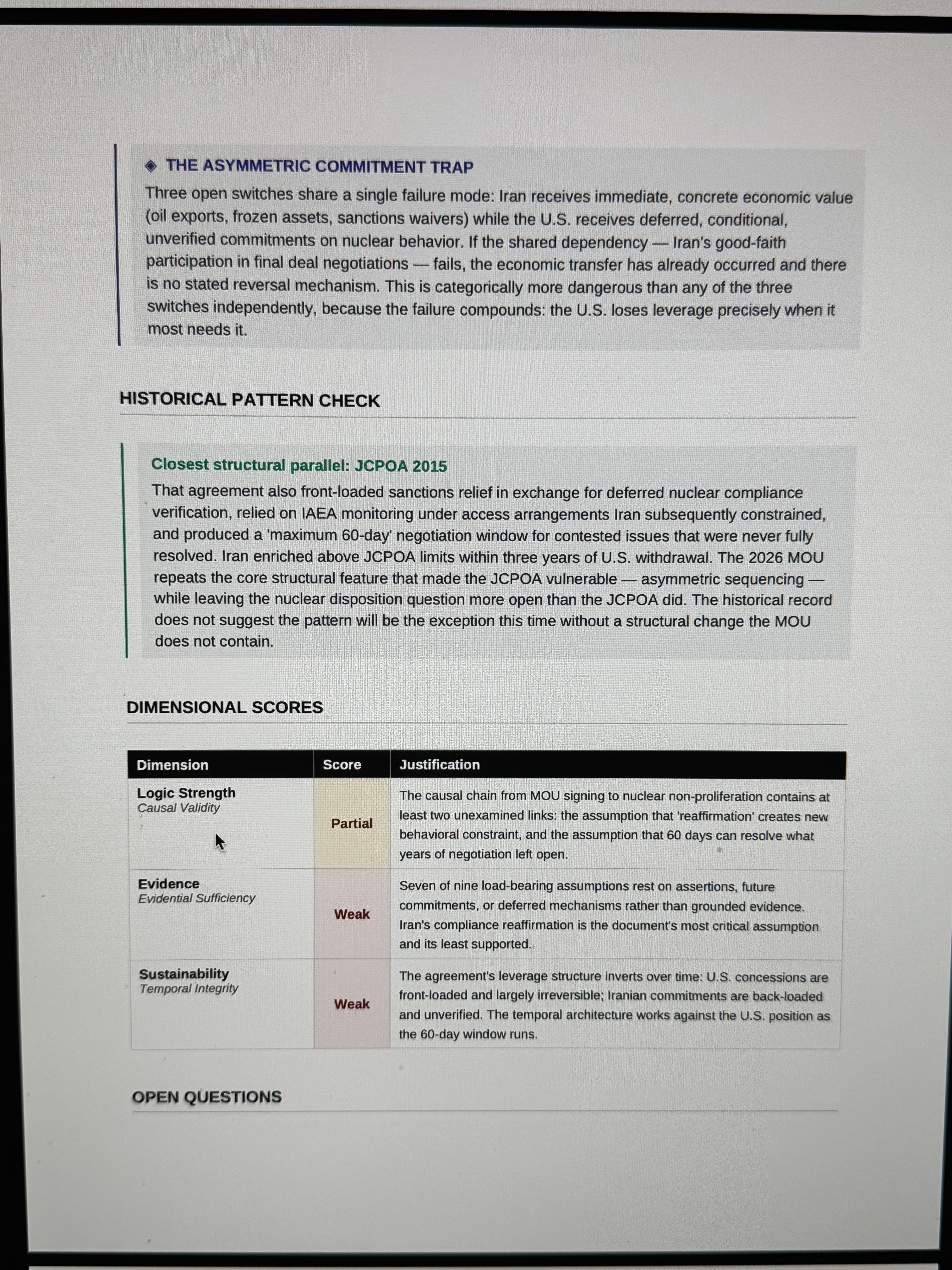
What it does find is that the agreement’s three hardest problems — Iran’s nuclear program, Israel’s behavior as a non-signatory actively operating in Lebanon, and a $300 billion reconstruction fund with no named contributors — are not solved. They are deferred. And the sequencing means the United States provides economic relief before those problems are resolved, spending the leverage that produced this agreement before the agreement’s hardest work begins.
This is what stress-testing reasoning looks like. It isn’t pessimism. It isn’t contrarianism. It’s the discipline of separating what has been established from what has merely been asserted — and refusing to let that difference collapse under the pressure of a good headline. In business, it shows you how confident you can be in a plan, proposal, or other assertion. It shows you how much of it survives the stress test, how much of it is investable.
The ten questions at the end of the analysis are not rhetorical. They are the specific conditions under which the rating changes. When those questions have answers, run it again. The score will move.
Until then, you have what the document actually supports.
Proving Ground is a decision integrity platform built by Fiduciari.ai. It stress-tests reasoning before consequential commitments are made. It returns decision authorship to you. If you’re interested in trying it when it launches, please send a LinkedIn PM to Mark Stouse with the word “Trial PG” in the headline.
This is fascinating analysis Mark - I wish I had a case study for Priving Ground ready to go. I’d be all over that trial. This is AI helping human judgment in action. Soooo much cooler than ‘do work for me’.
Wow, Mark. I think I am finally starting to understand and appreciate the power and potential of "Proving Ground"!!!